CPET vs PP Trays: Which Is Right for Your Food Packaging?
When it comes to top seal trays, two materials come up more than any other: CPET and PP. Both are widely used across food packaging, but they’re built for genuinely different jobs – and picking the wrong one can mean a tray that cracks in the oven, costs more than it needs to, or simply isn’t suited to how your product will be stored, reheated, or served.
At SystemPAK, our CPET trays sit within our OvenPAK range (including the smaller-format MenuPAK trays), and our PP trays form the core of our GastroPAK range – which also includes a small number of CPET size options. Here’s how to tell which one your business actually needs.
The Short Answer
If your product needs to go from freezer or fridge straight into an oven, CPET is the only sensible choice. CPET trays are dual ovenable, microwave safe, and freezer safe – but they cost more per unit.
If your priority is durable, cost-effective bulk packaging for catering or food service – without an oven requirement – PP is the better fit. PP trays are microwave safe and freezer safe, with a lower cost per unit thanks to better material yield, but they are not oven safe under any circumstances.
The deciding factor almost always comes down to one question: will this product, at any point in its life, go in an oven?
CPET: Built for Heat
CPET (Crystalline Polyethylene Terephthalate) is the material behind our OvenPAK range, including the smaller-format MenuPAK trays. Its defining feature is heat resistance – CPET trays are dual ovenable, meaning the same tray can go from freezer to conventional oven or microwave without losing structural integrity.
Where CPET makes sense:
- Ready meals designed to be oven-finished by the end customer
- Bake-off products that need oven contact as part of preparation or reheating
- Hot-fill applications where the tray is filled with hot product
- Retail packaging where “oven to table” convenience is part of the product’s appeal
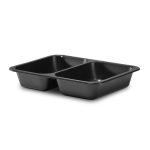
Our OvenPAK range spans a wide capacity range, from compact formats through to large-format options, in standard and multi-cavity (compartmentalised) formats – useful for ready meals with separate components, like a main and a side. All are dual ovenable and freezer safe.
The trade-off: CPET typically costs more than PP per unit, largely because of the material properties needed to survive oven temperatures. If your product never sees an oven, you’re paying for a capability you don’t use.
Browse the OvenPAK range
PP: Built for Volume
Polypropylene (PP) is the material behind the majority of our GastroPAK range – designed specifically for bulk food packaging in catering operations, commercial kitchens, and large-scale food production. PP is lightweight, durable, and microwave safe for reheating.
On freezer compatibility: standard PP trays are typically rated down to -20°C, which covers most commercial chilled and frozen storage requirements. For applications requiring deeper freeze performance, specialist PP polymers are available that extend this down to -40°C – a capability that is increasingly in demand across the industry and worth discussing with our team if your products require it.
It’s also worth noting that GastroPAK includes a small number of CPET tray sizes alongside the PP range, for customers who need oven-safe performance within a primarily catering-focused product selection.
Where PP makes sense:
- Bulk packaging of meat, poultry, fish, ready meals, and desserts for catering or foodservice
- High-volume operations where cost-per-unit matters at scale
- Products that are reheated in a microwave rather than an oven
- Catering and commercial kitchen environments rather than oven-to-table retail
The key reason PP works out more cost-effective is its specific gravity – it yields more trays per tonne of raw material than CPET, which translates directly into lower production costs. For high-volume packers, that difference adds up fast.
The trade-off: GastroPAK PP trays are explicitly not suitable for conventional oven use. If your product needs oven-safe packaging anywhere in its lifecycle – even just for the end customer – PP isn’t the right material.
Browse the GastroPAK range.
CPET vs PP: Quick Decision Guide
Ask yourself these three questions:
1. Will this product ever go in an oven – including by the end customer?
If yes, you need CPET (OvenPAK or MenuPAK). PP is not rated for conventional oven use, regardless of how it’s reheated afterwards.
2. Is this for high-volume catering or bulk foodservice packing?
If cost-per-unit and volume are the priority, and oven use isn’t required, PP (GastroPAK) is generally the more efficient choice.
3. Does the product need both freezer and microwave compatibility, without oven use?
Both materials cover this. For standard frozen storage, standard PP (rated to -20°C) is typically sufficient and more economical. Where extended freeze performance to -40°C is needed, ask us about specialist PP polymer options.
Sealing and Compatibility
Both ranges are designed to work with SystemPAK’s top seal film and heat sealing equipment, with peelable or weld-seal film options, including anti-fog variants where clear visibility of the product matters. GastroPAK trays are compatible with our manual and automatic heat sealers – our sales team can advise on the right pairing for your tray size and seal type.
FAQs
Can CPET trays be used in the freezer?
Yes – CPET (OvenPAK) trays are freezer safe as well as oven and microwave safe, making them suitable for products that go from frozen storage straight into the oven.
Is PP recyclable?
Yes, PP (GastroPAK) is 100% recyclable, and is a widely accepted material in UK recycling streams.
Why is PP cheaper than CPET?
PP’s specific gravity allows for a higher yield of trays per tonne of raw material, which lowers the production cost per unit compared to CPET. This makes PP especially cost-effective for high-volume packing.
Can I put a PP tray in the oven if I just heat it briefly?
No – GastroPAK PP trays are not rated for conventional oven use under any duration. For any oven application, including bake-off or reheating, CPET (OvenPAK or MenuPAK) is the correct material.
Which is better for ready meals?
It depends on how the meal is intended to be reheated. Oven-finished or “bake at home” ready meals need CPET. Meals designed purely for microwave reheating can use either material, with PP often the more cost-effective choice at volume.
What freezer temperature rating do PP trays have?
Standard PP trays are rated to -20°C, which covers the majority of commercial frozen storage applications. Specialist PP polymers rated to -40°C are also available for more demanding requirements – contact our team to discuss.
Do you offer free samples of CPET and PP trays?
Yes – samples of OvenPAK (CPET), MenuPAK, and GastroPAK (PP and CPET) trays are available; you’ll only need to cover postage.